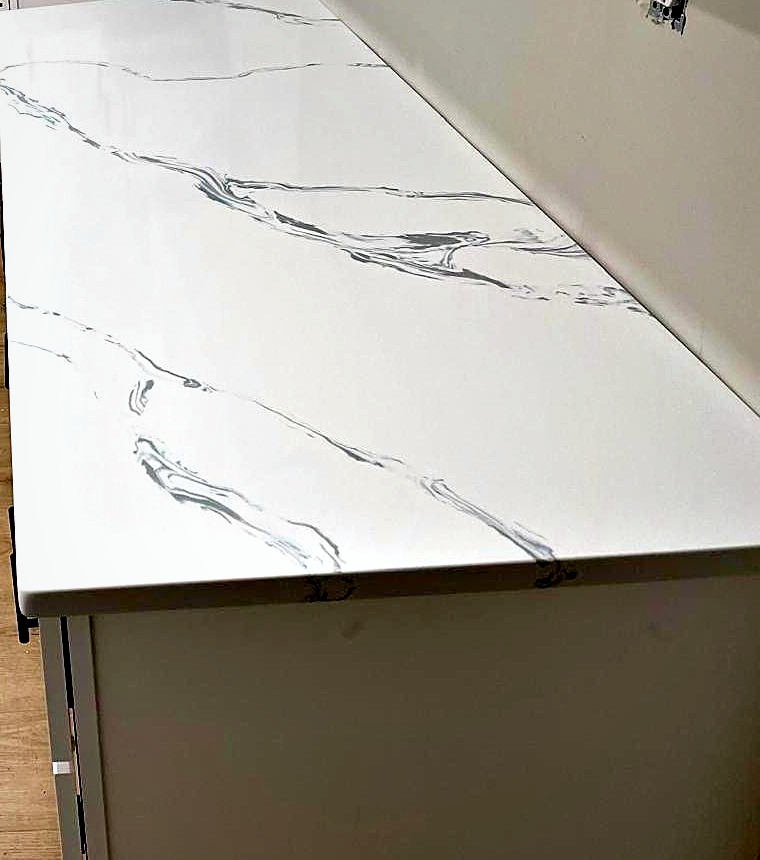
Countertops are one of the strangest purchases in a remodel: five companies can quote the "same" granite and come back thousands of dollars apart, with completely different ideas of what is included. After fabricating in Raleigh since 2009, we can tell you the difference almost never comes down to the stone. It comes down to the fabricator.
Here are the ten questions that expose the difference — including the ones we love being asked, and the ones some shops hope you never think of.
1. Will I pick my actual slab, or a sample?
Natural stone varies wildly within a single name. If you approve a three-inch chip, you are trusting someone else's judgment on the most visible surface in your home. A serious fabricator lets you choose your actual slab and tag it before anything is cut — we insist on it.
2. Is the quote itemized — and is it firm?
The classic trap is the teaser rate: a low per-square-foot number that quietly grows once cutouts, edges, tear-out and sealing get "added." Demand one page with everything on it: slab, fabrication, edge profile, sink cutouts, sealing, installation. Our cost guide shows what real installed pricing looks like.
3. Who actually fabricates the stone?
Some countertop companies are sales offices that subcontract cutting to whoever has capacity that week. Ask who actually cuts your slab, and whether fabrication is done in-house or handed off. In-house fabrication means the templater, the fabricator and the installer answer to the same standard — and to you.
4. How do you template?
Laser templating in your home, on your installed cabinets, is the difference between a seam that disappears and a gap you caulk. Be wary of quotes produced from a drawing alone — cabinets are never as square as the plans say.
5. Will I approve the layout on my slab before cutting?
Vein direction, where the pattern lands on the island, whether the movement flows through the seam — those decisions should be yours to approve on your actual slab before the saw starts. If a shop will not show you, the offcuts decide.
6. Where will the seams be?
A good fabricator tells you seam locations at templating and explains why. Seams belong away from sightlines and sink edges where possible — and a tight, color-matched seam is the signature of careful work.
7. What does your warranty actually cover?
"Warranty" can mean anything. Ask specifically: who stands behind the fabrication — the cuts, seams and edges — and for how long? Material warranties come from quarries and brands; workmanship is on the shop. Ours is simple: lifetime fabrication warranty — if any cut, seam or edge we made ever fails, we repair or replace it at no cost.
8. How long from template to install?
Vague timelines usually mean a subcontracted backlog. A fabricator who does its own cutting can commit: most of our kitchens install in a single day, often within the same week in normal season.
9. Who removes the old tops, and who handles plumbing?
Unglamorous, but this is where budgets quietly break. Get tear-out, disposal, and sink and faucet reconnection assigned in writing — included, excluded, or coordinated.
10. Can I see real local work and speak to real customers?
Reviews with project details beat star counts. Ask for local references with a similar project — a full kitchen, a waterfall island, an outdoor bar — and look at the seams in the photos, not just the pretty wide shots.
Red flags worth walking away from
- A price that cannot be itemized ("it is all included, trust me")
- Deposit demanded before any measure has happened
- Won't let you see and approve your actual slab before it's cut
- Templating from drawings without visiting the house
- "Warranty" with no written scope
- Pressure to decide today because "this slab will not last"
The checklist, condensed
| Ask | Good answer |
|---|---|
| Slab selection | Choose your actual slab, approve it |
| Quote | Firm, one page, everything itemized |
| Fabrication | In-house, one crew start to finish |
| Template | Laser, in your home, on installed cabinets |
| Layout | You approve veining on your slab pre-cut |
| Warranty | Written, covers fabrication, no expiry games |
| Timeline | Committed install date, most kitchens one day |
Bring this list to every fabricator you interview — including us. Book a free in-home measure and ask all ten; we have been answering them in Raleigh since 2009.
Comparing quotes apples-to-apples
Five quotes arrive five different ways: per-square-foot, lump-sum, "starting at," itemized, and verbal. Normalize them before comparing. Build one line for each of these and force every quote into it:
- Material (which slab, which grade — a name like "Alaska White" spans multiple grades)
- Fabrication (cutting, edge profile, seams)
- Cutouts (sink, cooktop, faucet holes — each one, priced)
- Tear-out and disposal of the old tops
- Installation and leveling
- Sealing
- Plumbing disconnect/reconnect (included, excluded, or "coordinate your own plumber")
The cheapest headline number is routinely the most expensive final invoice once the blanks fill in. Our cost guide publishes real installed ranges precisely so you have a baseline to test other quotes against.
What template day should look like
The measure appointment is your best preview of a shop's standards. A professional template visit: cabinets checked for level and square, every wall scribed (walls are never straight), overhangs discussed against your seating and appliance plans, seam locations proposed and explained, sink and faucet models confirmed on the spot, and edge samples physically in your hands. Thirty to sixty minutes, done with a laser. If the "template" is a tape measure and ten minutes, the seams will tell that story later — in your kitchen.
The timeline, phase by phase
| Phase | What happens | Your part |
|---|---|---|
| Slab selection | Choose your actual slab, approve it | Bring cabinet door + paint samples |
| Template | Laser measure on installed cabinets | Sink & faucet on site, final layout decisions |
| Layout approval | Your countertop drawn on your actual slab | Approve vein placement before cutting |
| Fabrication | Cutting, edging, polishing in-house | Nothing — this is our week |
| Install | Set, level, seam, seal — most kitchens in one day | Clear the counters, clear a path |
| Walk-through | Inspect seams & edges together, care guidance | Ask everything — this is the moment |
From template to install, ask every shop for a committed date in writing. In normal season we regularly template and install within the same week — capacity you only get when the same crew that templates your kitchen also cuts it in-house.
Insurance, lien waivers and the paperwork nobody reads
Two documents worth requesting from any shop, including us: a certificate of insurance (their general liability protects your home during tear-out and install — a 300-pound slab moving through a doorway is exactly what insurance is for), and a final lien waiver on completion if the countertops are part of a larger financed remodel. Reputable fabricators produce both without friction; hesitation is data.
Why we publish this playbook
Handing homeowners a checklist that works against bad quotes costs us the customers we'd never want and wins us the ones who compare carefully. Every question in this guide is one we answer happily at a free in-home measure — the slab is yours to choose, the quote arrives itemized on one page, and the fabrication carries a lifetime warranty. That's the answer key; grade every shop against it, including ours.