
Ⅵ · Outdoor kitchens · Raleigh, NC
Outdoor Kitchen Countertops in Raleigh, NC
UV-stable granite built for Carolina summers — grill stations, bar tops and full outdoor kitchens, fabricated to the same millimeter standard as everything we put indoors.
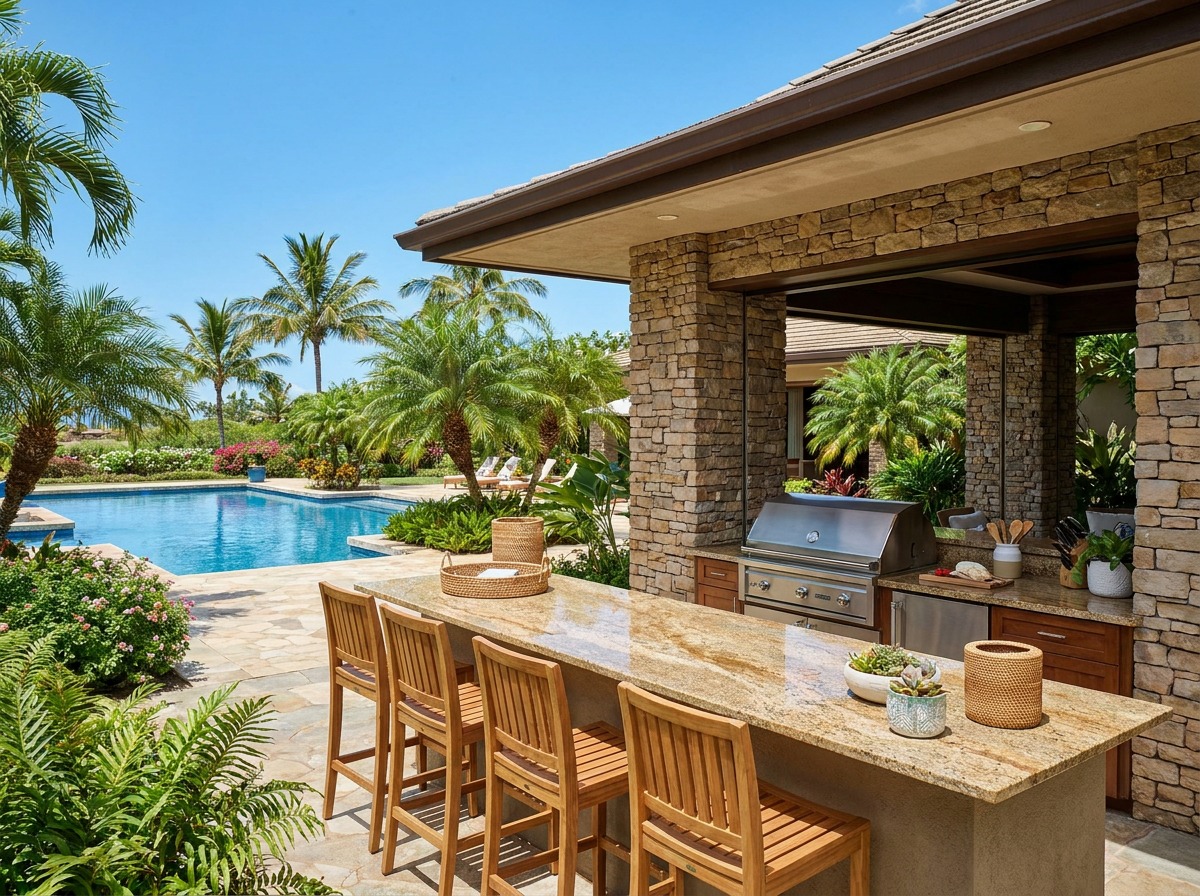
Stone that survives a Carolina summer
Outdoor counters live a harder life than anything in your kitchen: July sun, thunderstorm cycles, grill heat, winter freezes. Most surfaces fail out here — engineered quartz yellows in UV, and budget materials crack at the first hard freeze. We build outdoor kitchens exclusively from UV-stable granites chosen for exactly this duty, sealed for weather, cut for drainage.
From grill station to full outdoor bar
A grill surround with landing zones. A bar top with a twelve-inch seating overhang. A full L-shaped outdoor kitchen with sink, fridge opening and trash pull-out. Every one starts with an on-site template and slab selection, and ends with an installed piece backed by the same lifetime fabrication warranty as our indoor work — because weather is not an excuse for seams that open.
Why the wrong stone fails outdoors
Indoors, almost any countertop survives. Outdoors, the Carolina climate is brutal on the wrong material. Engineered quartz is the most common mistake — its resin binder yellows and breaks down under direct UV, which is why manufacturers void their warranties for outdoor use. Marble etches under acidic rain and pollen and stains from grill grease. Softer or dyed budget stones fade in a season and crack when trapped moisture freezes and expands. Natural granite is different: it was formed by heat and pressure, so sun, rain and grill flare-ups don't faze it — and dense, low-absorption granites shrug off our freeze-thaw winters when they're sealed and cut for drainage. Choosing the right slab is the single decision that determines whether your outdoor kitchen looks new in ten years or tired in two.
Built for the Triangle's freeze-thaw winters
Raleigh doesn't get a brutal winter, but it gets the worst kind for stone: repeated freeze-thaw cycles where daytime rain soaks in and overnight cold freezes it. Water expands as it freezes, and in a porous or poorly sealed surface that expansion is what cracks edges and opens seams. We build around it. Slabs are sealed for weather resistance, edges and drip lines are cut so water sheds instead of pooling, and seams are placed and set to move with temperature swings rather than fight them. The base cabinetry matters too — outdoor runs need weatherproof, non-rotting supports, not the indoor boxes a shortcut crew might reuse. It's the difference between an outdoor kitchen that's a Carolina asset and one that becomes a spring repair bill.
Designing the layout around how you actually cook
The best outdoor kitchens are planned around the cook, not the catalog. A grill needs landing zones on both sides — hot pan to the right, prep to the left — or you'll be juggling plates over open flame. A bar top earns its keep with a twelve-inch overhang so guests can sit without kneeing the cabinet. Appliance cutouts for a sink, a fridge, a trash pull-out and a side burner all get templated to the exact model so nothing arrives a half-inch off. And traffic flow — grill, prep, serve, sit — should move in one direction so the cook isn't fighting the crowd. We map all of it on-site before a single slab is cut, then coordinate the cabinetry so the whole space reads as one build.
Outdoor questions
Outdoor kitchen FAQs
What's the best countertop material for an outdoor kitchen?
UV-stable granite. It shrugs off Carolina sun, rain and grill heat without fading or degrading. Engineered quartz doesn't belong outdoors — its resin binder yellows in direct UV — which is exactly why we steer outdoor projects to the right granites instead.
Can you build a full outdoor bar, not just a grill surround?
Yes — from a simple grill station to a full outdoor bar with seating overhangs, sink cutouts and appliance openings, fabricated to the same exacting tolerances as our indoor work.
How are outdoor kitchens priced?
Per project, after a free on-site measure — footprint, stone selection and appliance cutouts drive the number. The quote is a firm installed figure, and the fabrication carries the same lifetime warranty as everything we cut.
Does outdoor granite need special care?
Sealed at installation like indoor granite, with periodic resealing — outdoors we recommend staying on schedule since the surface lives in the weather. Beyond that: soap, water, and decades of service.
Can outdoor granite survive Raleigh winters?
Yes — dense, low-absorption granites handle the Triangle's freeze-thaw cycles when they're properly sealed and cut so water sheds instead of pooling. That drainage-and-sealing detail is what prevents the cracked edges you see on outdoor stone that was installed like an indoor top.
Why can't I use quartz outdoors?
Engineered quartz uses a resin binder that yellows and degrades under direct UV — manufacturers void their warranties for outdoor use. For outdoor kitchens, natural UV-stable granite is the right call; quartz belongs indoors.
What should an outdoor kitchen layout include?
Landing zones on both sides of the grill, a seating overhang of about twelve inches for a bar, and appliance cutouts templated to your exact sink, fridge and burner models. We plan the flow — grill, prep, serve, sit — on-site before cutting anything.
Do you build the base and cabinetry too, or just the countertop?
Both — and outdoor bases need weatherproof, non-rotting supports rather than reused indoor boxes. We coordinate the countertop and the structure so the finished space holds up to the weather as one build.
Building the whole space? Pair UV-stable granite or dramatic quartzite with custom cabinetry, and see the cost guide.
Free in-home measure · Raleigh & the Triangle
Build the backyard kitchen that lasts.
On-site measures across Raleigh, Durham, Cary, Apex, Wake Forest, Chapel Hill, Garner, Holly Springs and Morrisville.