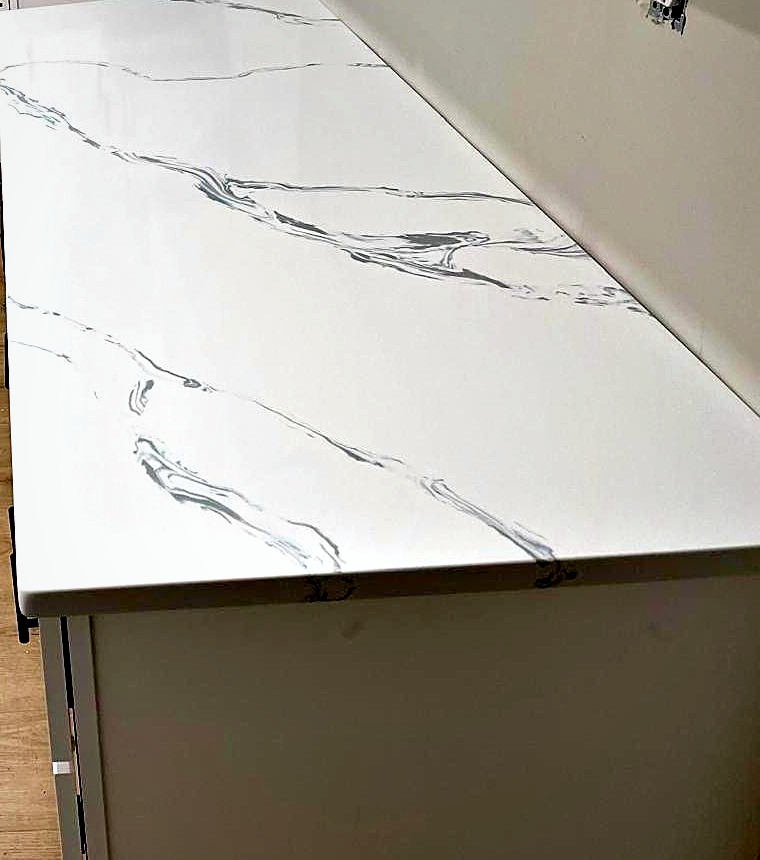
Every countertop quote we produce in Raleigh has a line item most homeowners have never thought about until that moment: the edge profile. It's the shape we cut and polish into the exposed edges of your stone — and it changes how the countertop looks, how it feels every time you lean against it, and what you pay.
This guide covers every edge profile we cut at Stone Forever, which ones are included in a standard quote, which are upgrades, and how to match a profile to your stone and your kitchen. It applies equally to granite, quartz, marble and quartzite.
What is a countertop edge profile?
A countertop edge profile is the finished shape cut into the visible edge of a stone countertop — from a simple softened square to a decorative multi-step curve. The profile is precision-cut and hand-polished, and because it runs along every exposed inch of your countertop, it has an outsized effect on the final look of the kitchen.
The profiles, from simple to sculptural
Eased edge
A square edge with the sharp corner softened just enough to be safe and chip-resistant. This is the default modern edge — it lets dramatic stone do the talking and suits flat-panel and Shaker kitchens alike. Included in most standard quotes.
Bevel edge
The top corner is cut at a crisp 45-degree angle, catching light along the line. Slightly more tailored than an eased edge, still firmly contemporary. Usually a modest upgrade over eased.
Bullnose and demi-bullnose
The classic fully-rounded edge (bullnose) or rounded-top-square-bottom (demi-bullnose). Comfortable, traditional, forgiving with kids in the house — and the demi version keeps a visually thinner line while staying soft to the touch. Common upgrade tier.
Ogee edge
An S-shaped decorative curve that reads unmistakably traditional. Ogee belongs on raised-panel cabinetry, warm granites and marble — it can make a modest kitchen feel like a library. Because it removes more material and takes longer to polish, it sits in the upper upgrade tier.
Dupont edge
A step followed by a quarter-round curve — ogee's more architectural cousin. It photographs beautifully on islands and pairs especially well with veined marble and quartzite.
Mitred waterfall edge
Not a shaped edge but a construction technique: the stone turns 90 degrees and runs down the side of the island to the floor, with the vein pattern flowing continuously around the corner. This is the signature edge of contemporary statement kitchens, and it's a fabrication test — a poorly-cut mitre shows a dark seam line where the veins should flow. It's the most involved option we cut, priced by the linear foot at your measure.
Edge profile comparison
| Profile | Style | Price tier | Best with |
|---|---|---|---|
| Eased | Modern, minimal | Included* | Any stone, flat-panel & Shaker kitchens |
| Bevel | Tailored modern | Modest upgrade | Quartz, dark granites |
| Demi-bullnose | Soft transitional | Upgrade | Busy granites, family kitchens |
| Bullnose | Traditional | Upgrade | Granite, marble vanities |
| Ogee | Formal traditional | Upper tier | Raised-panel cabinetry, marble |
| Dupont | Architectural | Upper tier | Veined marble & quartzite islands |
| Mitred waterfall | Statement contemporary | Priced per linear foot | Quartzite & quartz islands |
*In most Stone Forever quotes, an eased or beveled edge is included — our Raleigh cost guide explains exactly what a standard installed price covers.
How to choose: three questions we ask at every measure
- What is your cabinet door style? Flat-panel and Shaker doors want eased, bevel or waterfall. Raised-panel doors earn ogee and dupont.
- Who uses this kitchen? Toddlers at counter height argue for a rounded profile. Serious cooks who lean into the counter all day often prefer the feel of an eased edge.
- Is the stone the star? Heavily-veined quartzite deserves a simple edge or a waterfall — a decorative profile competes with the stone. Quiet, uniform stones can carry an ornate edge.
What edge profiles cost in Raleigh
Edge complexity is one of the four variables that move a countertop quote — alongside slab grade, layout and cutouts. In our pricing, standard edges are built into the installed rate (granite from $35/sq ft, quartz from $45/sq ft), decorative profiles add a per-linear-foot upgrade quoted at your free in-home measure, and mitred waterfalls are priced per edge. Every number lands on one itemized page — the way a fabricator quote should always arrive.
Which edges suit which stones
Edge and stone are a pairing, not separate decisions. A few rules we've learned cutting all four stones for Raleigh kitchens since 2009:
- Granite takes every profile well — its density polishes crisply even on ornate ogee curves. Busy granite patterns pair best with simpler edges; quiet granites like an absolute black can carry decoration.
- Quartz machines beautifully and holds razor-straight lines, which is why eased, bevel and mitred waterfall dominate quartz kitchens. Ornate traditional profiles on a factory-consistent surface can read as a mismatch — we'll show you samples before you commit.
- Marble and ogee were made for each other — the soft stone takes a warm, hand-carved-looking curve. For marble vanities, a simple eased edge keeps a small room feeling modern instead of ornate.
- Quartzite is the waterfall stone. Its hardness holds the mitre's knife-edge corner, and dramatic veining flowing around a 90-degree turn is the whole point of paying for quartzite.
Thickness, laminated edges and the "chunky" look
Edge profile and edge thickness get decided together. Standard slab thickness reads as a clean, contemporary line. For the substantial, furniture-like look — a thick island edge you see in design magazines — fabricators build a laminated edge: a strip of the same stone bonded and polished beneath the perimeter so the edge reads double-thick while the field stays standard. Done well, the glue line disappears inside the profile; done badly, it's a visible stripe at eye level. It's exactly the kind of detail to inspect in a fabricator's portfolio before hiring them — look at edge close-ups, not just wide shots.
A mitred build-up achieves the same mass with the veining turning the corner instead of a bonded strip — cleaner on dramatic stones, more fabrication hours, priced accordingly.
The three mistakes we see most
- Choosing from a drawing. A profile that looks delicate in a diagram can feel sharp at hip height. At your template we bring physical edge samples — run your hand along them, then decide.
- Over-decorating a dramatic slab. Ornate edge + bold veining = visual competition. One of them should whisper.
- Ignoring the sink reveal. Your edge profile continues into the sink cutout on an undermount. Rounded profiles soften the daily wipe-down into the basin; crisp square reveals collect less visual grime but demand tighter fabrication tolerances. Ask how the profile terminates at the sink — the answer tells you how carefully a shop thinks.
How your edges are actually cut
Every Stone Forever edge is cut to a repeatable tolerance along the full run — including the curves hand tools wander on. Then comes staged polishing: progressively finer abrasives until the edge matches the factory polish of the slab face. The difference between a $200 edge and a $2,000-looking one isn't the profile you picked — it's whether the polish carries the stone's full depth of color around the curve. Drag a fingernail across a poorly polished ogee and you'll feel the facets; a properly finished one feels like one continuous surface. That finish quality is covered by our lifetime fabrication warranty like every cut we make.