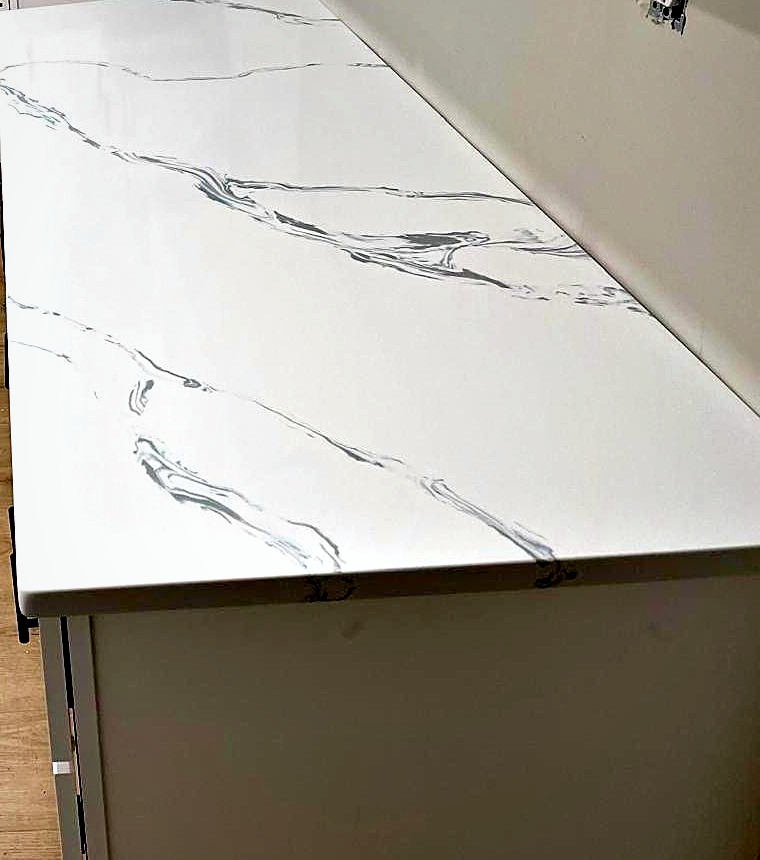
The fastest way to shorten a countertop's life is not dropping a pan on it — it is cleaning it with the wrong bottle every day for five years. The right routine takes under a minute and differs by stone. Here is the exact guidance we give every Raleigh homeowner at installation, for all four surfaces we fabricate.
The one rule that covers every stone
Warm water, a drop of mild dish soap, a soft cloth. That combination cleans granite, quartz, marble and quartzite safely, every day, forever. Everything else in this guide is about what to add for specific stones — and what to keep away from them.
How to clean granite countertops
- Daily: soap and water. Dry with a microfiber cloth to avoid water spots on dark stones.
- Avoid: vinegar, lemon-based sprays, ammonia and abrasive powders — they do not hurt the granite, they strip the sealer that protects it.
- Sealing: we seal every granite top at installation; a yearly wipe-on reseal (15 minutes, hardware-store product) keeps it stain-resistant. Water beading on the surface means the seal is healthy; water darkening the stone means it is time.
- Spills: blot oil and wine promptly. A sealed granite top gives you plenty of time — an unsealed one does not.
How to clean quartz countertops
- Daily: soap and water — that is genuinely the whole routine. Quartz is non-porous and never needs sealing.
- Avoid: abrasive scouring pads, oven cleaner, paint thinner and high-pH degreasers — harsh chemistry can dull the resin binder over time.
- Heat: this is quartz's one rule. Use trivets. Sustained direct heat can mark the resin where natural stone would shrug it off.
- Dried-on mess: a plastic scraper and warm soapy water — never a metal blade or green scouring pad.
How to clean marble countertops
- Daily: pH-neutral stone soap or plain soap and water. Nothing acidic — ever.
- Avoid: vinegar, citrus cleaners, and letting wine, coffee or lemon juice sit. Acids physically etch marble — a dull mark no sealer can prevent, because it is chemistry, not staining.
- Sealing: more often than granite — we recommend staying on a regular schedule, and we set it with you at installation based on the stone.
- Mindset: households that love marble embrace patina. If a developing surface would bother you, our materials comparison points you to quartzite instead.
How to clean quartzite countertops
- Daily: soap and water, same as granite.
- Sealing: sealed at installation, periodic reseal keeps it stain-resistant. Quartzite does not etch from acids the way marble does — one of the reasons it is the connoisseur's pick for working kitchens.
- Avoid: the same sealer-stripping products as granite: vinegar, ammonia, abrasives.
Care cheat sheet
| Stone | Daily clean | Sealing | Never use | Watch for |
|---|---|---|---|---|
| Granite | Soap & water | Yearly | Vinegar, ammonia, abrasives | Water stops beading → reseal |
| Quartz | Soap & water | Never | Scouring pads, harsh solvents | Direct heat — use trivets |
| Marble | pH-neutral soap | Regularly | Anything acidic | Acid etching from citrus & wine |
| Quartzite | Soap & water | Periodic | Vinegar, ammonia, abrasives | Same as granite |
Stain response, step by step
- Blot, do not wipe — wiping spreads oil and wine into a wider footprint.
- Clean with soap and water, dry, and assess in daylight.
- For set-in stains on natural stone, a poultice (a paste that draws the stain out of the pore structure) over 24 hours handles most oil and organic marks — the Natural Stone Institute publishes stone-care guidance we point customers to.
- If a mark will not move, call us before trying anything aggressive — (984) 983-4848. Every top we fabricated carries a lifetime warranty on the fabrication, and we would rather look at it early.
The annual granite reseal, step by step
Homeowners sometimes assume resealing is a service call. It's a 15-minute DIY job:
- Test first. Pour a tablespoon of water on the counter and wait 10 minutes. Beads sitting proud? Your seal is fine — skip this year. Darkening ring? Continue.
- Clean and dry completely — soap and water, then let it dry fully so you're not sealing moisture in.
- Apply a penetrating stone sealer (hardware-store impregnating sealer for granite) with a soft cloth, working in sections.
- Let it dwell per the label, then wipe every trace of excess off — residue left to dry is the #1 DIY mistake; it hazes.
- Cure — avoid wetting the surface for the window the label specifies.
Same process applies to quartzite. If your top came from us and you'd rather we walk you through it live, call (984) 983-4848 — it's a two-minute conversation.
Etching vs. staining: know which problem you have
These get confused constantly, and the fix is opposite:
| Stain | Etch | |
|---|---|---|
| What it is | Something soaked into the pores (oil, wine) | Acid dissolved the polished surface itself |
| Looks like | Darker patch | Dull, lighter, "water-ring" mark |
| Feels like | Same as surrounding stone | Slightly rougher under a fingertip |
| Fix | Poultice draws it out | Mechanical re-honing/polishing |
| Prevention | Sealer | Nothing but habits — no sealer stops chemistry |
Marble etches; granite and quartzite effectively don't in kitchen use; quartz doesn't etch but its resin can dull from harsh chemistry — different mechanism, same lesson about keeping aggressive cleaners away.
Outdoor countertop care
An outdoor kitchen lives in UV, pollen, thunderstorms and freeze cycles, so the routine tightens: stay strictly on the reseal schedule (weather works sealer harder than any kitchen), rinse pollen season off rather than letting it bake in, and cover or clear standing water before hard freezes. Granite chosen for outdoor duty handles all of it — the care difference is cadence, not chemistry.
The seasonal 10-minute checklist
- Monthly: resight your caulk lines at the backsplash and sink — gaps let water reach what stone protects.
- Quarterly: water-bead test on natural stone; deep-clean the sink reveal edge where grime hides.
- Yearly: reseal granite/quartzite as needed; check seams — a hairline that catches a fingernail is a warranty call, not a DIY project.
- Never: stand on the counters, use them as a cutting board (bad for knives, dulls the polish line), or let a "miracle shine" spray near natural stone without reading its acid content.
Everything structural — cuts, seams, edges — stays covered by our lifetime fabrication warranty, so when in doubt, photograph it and text us before experimenting.